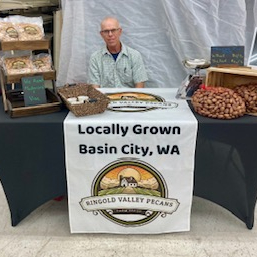
Ringold Valley Pecans
Ringold Valley Pecans
Contact: Mark Guilbeau
Address: 400 Greenar Lane Mesa, WA, 99343
County: Franklin
About Us
Our Family Farm and Pecan Production
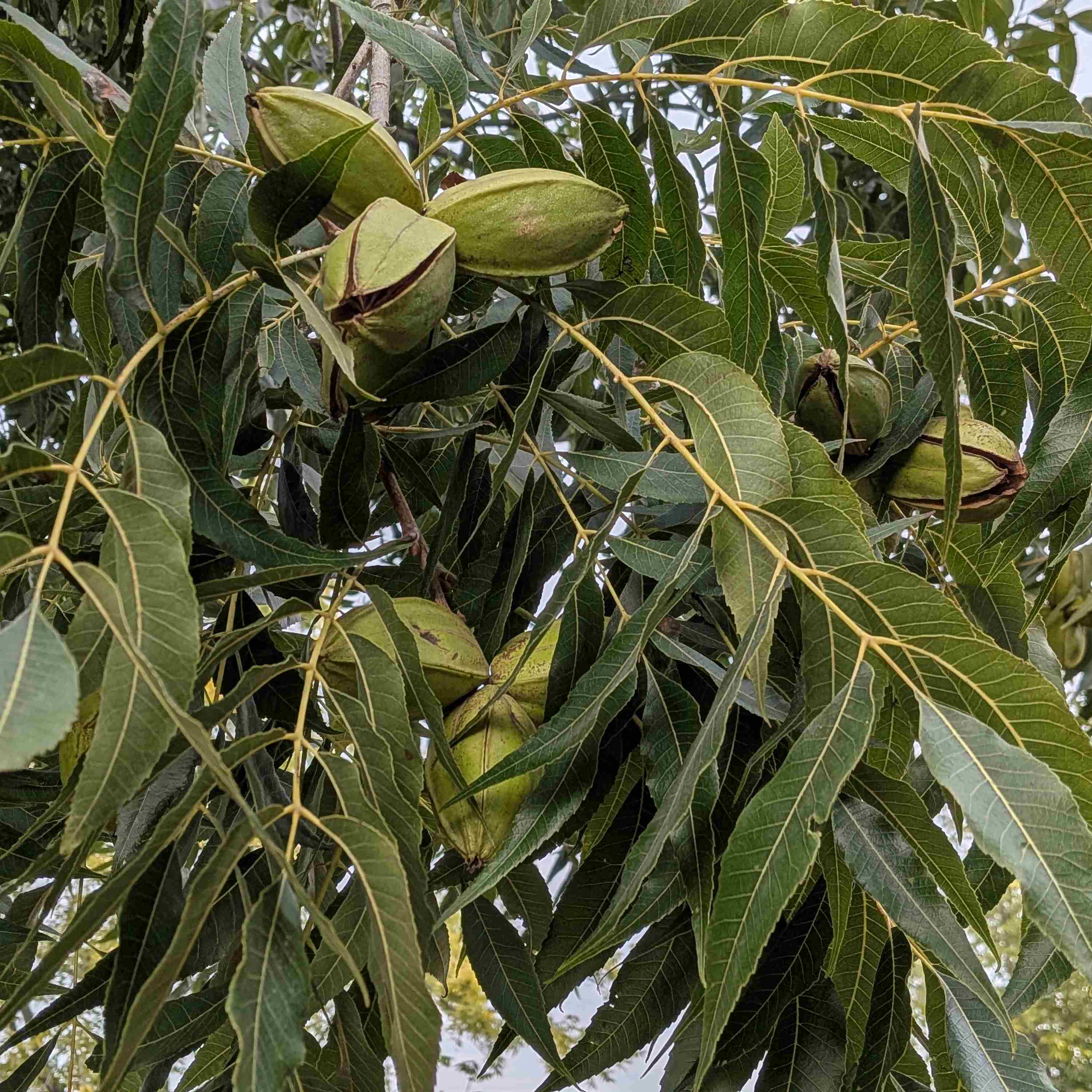
We grow pecans in Eastern Washington as a small family-farm operation of about 150 northern variety trees. The trees flower and cross pollinate in April with the nuts maturing all summer and into late fall. The yield varies depending on the weather, with some seasons producing heavily and others less so.
Flavor and Texture of Our Pecans
Once mature, our pecans are known for their excellent flavor straight from the tree, accompanied by a slightly chewy texture. Many of our customers who prefer a crispier texture achieve this by placing the nuts in a food dehydrator, or oven at a very low temperature. This process also enhances the sweetness and full-bodied flavor while still preserving raw, healthy essential oils.
Harvesting and Drying Practices
Our harvesting methods are specifically designed to maintain the natural flavor and essential oils of the pecans. After hand-picking in late November, the nuts air dry to achieve a 4% moisture reading. Following drying, they are stored in a freezer until time to crack and remove the shells.
Sanitizing and Shelling Process
To ensure food safety, we boil the nuts in their shells for three minutes to sanitize the outer shell. Next, the nuts are placed into a sanitized sheller, which cracks the shells, sorts the nut meat, and deposits it into a bin while simultaneously blowing out most of the shell bits and other debris.
Hand Sorting and Packaging
The final step in our process is hand sorting all the nut meats to remove any remaining shell fragments. The cleaned pecans are then packed into vacuum-sealed bags, labeled, and frozen once again to preserve their freshness until sold.
Distinctive Quality of Ringold Valley Pecans
Our Ringold Valley Pecans feature a golden-blonde coloring, setting them apart from most commercially sold nuts that are typically much darker. This lighter color is a sign of freshness, whereas darker nuts indicate aging and lesser quality.
We grow pecans in Eastern Washington as a small family-farm operation of about 150 northern variety trees. The trees flower and cross pollinate in April with the nuts maturing all summer and into late fall. The yield varies depending on the weather, with some seasons producing heavily and others less so.
Flavor and Texture of Our Pecans
Once mature, our pecans are known for their excellent flavor straight from the tree, accompanied by a slightly chewy texture. Many of our customers who prefer a crispier texture achieve this by placing the nuts in a food dehydrator, or oven at a very low temperature. This process also enhances the sweetness and full-bodied flavor while still preserving raw, healthy essential oils.
Harvesting and Drying Practices
Our harvesting methods are specifically designed to maintain the natural flavor and essential oils of the pecans. After hand-picking in late November, the nuts air dry to achieve a 4% moisture reading. Following drying, they are stored in a freezer until time to crack and remove the shells.
Sanitizing and Shelling Process
To ensure food safety, we boil the nuts in their shells for three minutes to sanitize the outer shell. Next, the nuts are placed into a sanitized sheller, which cracks the shells, sorts the nut meat, and deposits it into a bin while simultaneously blowing out most of the shell bits and other debris.
Hand Sorting and Packaging
The final step in our process is hand sorting all the nut meats to remove any remaining shell fragments. The cleaned pecans are then packed into vacuum-sealed bags, labeled, and frozen once again to preserve their freshness until sold.
Distinctive Quality of Ringold Valley Pecans
Our Ringold Valley Pecans feature a golden-blonde coloring, setting them apart from most commercially sold nuts that are typically much darker. This lighter color is a sign of freshness, whereas darker nuts indicate aging and lesser quality.
Practices
We do not use chemical insecticides or fungicides on our pecan trees. Occasional aphid infestations are controlled with a plant-based oil application. Most weed control is achieved by mowing, allowing the organic material to decompose naturally into the soil, promoting healthy soil bioactivity. Minimal herbicide application is used in the tree rows where mowing is not possible. In early spring, we apply a general fertilizer blend to support the pecan trees + high nitrogen needs. Zinc is a micronutrient pecans roots have trouble absorbing from the soil, so foliar application is applied with a large blast sprayer to the leaves as needed. Since our location is far outside the traditional pecan-growing regions, we can avoid regular chemical applications commonly used elsewhere.